
Business Process Automation Isn’t Enough
Unlike traditional automation, which follows predefined rules, AI teammates operate across three capabilities

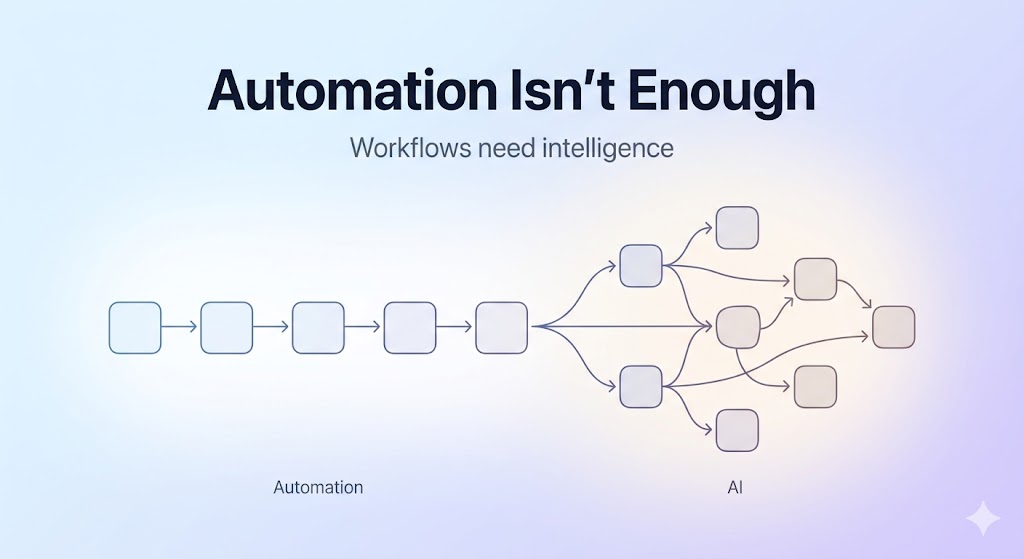
Most automation systems don’t break.
They degrade.
Reports still get generated.
Workflows still run.
Dashboards still update.
But underneath:
- Data requires manual correction
- Exceptions pile up
- Teams quietly compensate
And over time, the system that was meant to reduce work becomes something the team has to constantly manage.
This is where many automation strategies start to lose value.
A significant proportion of automation initiatives fail to deliver expected results, not because the technology is flawed, but because organisations apply rule-based systems to problems that require reasoning.
The gap is not in execution.
The gap is in understanding.
And that is where a new category is emerging:
AI Teammates.
What Are AI Teammates?
AI Teammates are systems that do not just execute tasks, but understand context, make decisions, and adapt workflows over time.
Unlike traditional automation, which follows predefined rules, AI teammates operate across three capabilities:
Perception
Understanding signals across systems, including structured and unstructured data.
Reasoning
Evaluating context, identifying patterns, and determining the best course of action.
Execution
Taking action within workflows, systems, and processes.If you want a deeper breakdown, read:
➡ [What Is Agentic AI?]
The Real Problem: You’re Using Execution Tools for Thinking Problems
Traditional automation tools like RPA were designed for execution.
They do exactly what they are told.
Nothing more.
This works well in stable environments where:
- Inputs are predictable
- Rules are fixed
- Exceptions are minimal
But modern business processes don’t behave like that.
They involve:
- Multiple data sources
- Changing formats
- Edge cases
- Context-dependent decisions
When organisations try to solve these problems using rule-based automation, they compensate by adding layers of logic.
Over time, the system becomes:
- Hard to maintain
- Difficult to debug
- Expensive to scale
This is not an implementation issue.
It is a design mismatch.
RPA vs AI Teammates
| Capability | RPA (Automation) | AI Teammates (Agentic AI) |
| Logic | Rule-based | Context-based |
| Data Handling | Structured only | Structured + unstructured |
| Adaptability | Breaks when conditions change | Adapts to change |
| Maintenance | High (15–50% annually) | Declines over time |
| Decision Making | Not supported | Built-in |
RPA executes.AI teammates interpret, decide, and execute.
Where Traditional Automation Breaks Down
Sales Reporting Across Multiple Systems
A pharmaceutical company operating across multiple distributors attempted to automate sales reporting.
Each distributor provided data differently:
- Different formats
- Different structures
- Different naming conventions
The initial automation worked for standard cases.
But as variation increased, so did:
- Manual corrections
- Reporting delays
- Error rates
What was designed to eliminate two weeks of manual work ended up reintroducing manual effort in different forms.
The CFO Reality: Where the Real Cost (and Opportunity) Sits
The real cost of this problem is not just operational inefficiency.
It is decision latency.
In the same pharmaceutical example:
- One experienced team member spent ~2 weeks every month preparing reports
- Even after that effort, errors in formulas and data inconsistencies remained
- By the time insights were ready, the data was already outdated
This created a structural constraint:
Decisions were made monthly instead of daily.But the underlying data was already available daily.
What Changed with AI Teammates
When reporting was enabled through an AI teammate:
- Data consolidation moved from 2 weeks → near real-time
- Reporting frequency shifted from monthly → daily visibility
- Errors reduced significantly through automated validation
This created a second-order effect:
Decision cycles accelerated.
Teams could now:
- Adjust promotions faster
- Respond to demand shifts earlier
- Correct underperforming regions in near real-time
The Commercial Impact
This is where CFOs start paying attention.
Faster decision-making doesn’t just save time.
It changes revenue dynamics.
In scenarios like this, organisations typically see:
Typical uplift range: 5–10% increase in sales
Not because of automation alone.
But because:
- Decisions happen faster
- Corrections happen earlier
- Opportunities are captured before they decay
The value is not in the report.
The value is in how quickly the business can act on it.
How AI Teammates Actually Work in Production
The difference between traditional automation and AI teammates is not speed.
It is how decisions are made inside workflows.
AI teammates introduce a reasoning layer that sits between data and execution.
This allows them to:
Interpret variation
Handle inconsistent formats across systems without rigid mappings.
Evaluate context
Understand when rules should apply and when they should adapt.
Continuously improve
Learn from patterns instead of requiring manual rewrites.
This is what enables systems like ROT Sasha to operate reliably in environments where traditional automation becomes brittle.
G-Tech Digital Asia: Removing Production Constraints
G-Tech deployed ROT Sasha for image production workflows.
The results:
- Error rates reduced to 0.1% acceptable levels
- Output consistency improved
- Processing scaled without additional headcount
The shift was not just operational.The team moved from repetitive execution to higher-value creative work.
The Hidden Cost of Maintaining Automation
Automation costs are rarely front-loaded.
They accumulate over time.
RPA systems require continuous:
- Break-fix adjustments
- Testing cycles
- System reconfiguration
- Manual oversight
Maintenance costs can reach 15–50% annually.
What appears to be a $100,000 automation project can evolve into a $225,000–$250,000 long-term cost, without being recognised as a failure.
Because technically:
The system is still running.
Why AI Teammates Are Replacing Traditional Automation
Organisations adopting AI teammates are not just improving efficiency.
They are restructuring how work gets done.
Reduced maintenance overhead
Less reliance on constant reconfiguration.
Improved decision quality
Context-aware execution instead of rigid rules.
Faster execution cycles
From weeks to hours.
Higher team productivity
Teams focus on outcomes instead of system maintenance.
The Future of Automation Is Not More Automation
The next phase of enterprise automation will not be defined by better tools.
It will be defined by systems that can think.
RPA solved execution.
Agentic AI introduces decision-making into workflows.
AI does not remove complexity.
It exposes it.
And the organisations that succeed will not be those that automate the most.They will be those that act the fastest on the right information.
Conclusion
Business process automation is not obsolete.
But it is no longer sufficient.
Rule-based systems work for predictable tasks.
But modern workflows require systems that can interpret, adapt, and improve.
That is the role of AI teammates.
The real question is not:
“Should we automate this process?”
It is:
“How quickly can we turn information into action?”
About AISensum
AISensum builds agentic AI Teammates that augment your workforce, not replace it. Our three AI Teammates; ROI Daniel (sales optimisation), ROT Sasha (operational automation), and ROQ Nicole (quality control) are deployed across enterprises globally and in Indonesia, delivering measurable results through proven implementation partnerships.
Ready to transform your business with agentic AI? Schedule a demo with our team or chat with AI Vivek for instant answers about your specific use case.
Frequently Asked Questions
No. The most effective architecture combines both. RPA handles structured execution, while AI teammates handle reasoning and decision-making.
Typical implementations take 4–8 weeks, depending on complexity. Initial value is often visible within the first month.
Most organisations see measurable improvements within 3–6 months, with early gains in time savings and faster decision-making.
Yes. They integrate with ERP, CRM, data platforms, and other enterprise systems through APIs and workflow orchestration.
18 years in Digital Marketing and AI in Indonesia. Championing the 'Human in the Lead' movement by deploying AI Teammates that streamlines execution, elevates frontline talent, and keeps human strategy in command.