Where the Brand is Made: How Nicole helped a retail chain hear every conversation at the counter

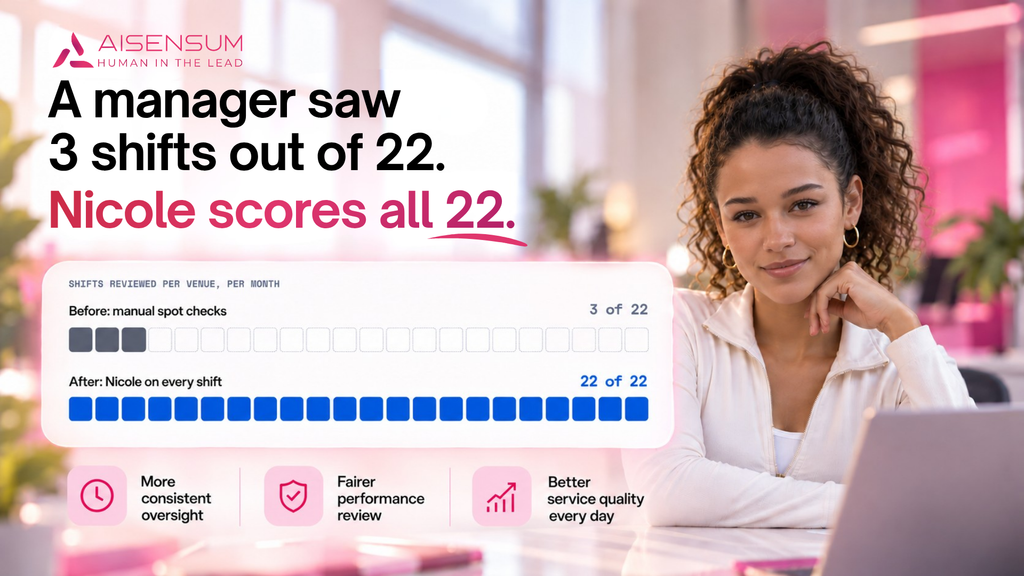
A brand lives in every conversation at the counter, from the first hello to the offer to the thank you. Most of them go unseen. Nicole, an AI agent with a human in the lead, is changing that.
It is a little after seven on a busy Friday evening, and the queue at the counter is long. The Cashier at the till has said “good evening” perhaps a hundred times since her shift began, and she will say it fifty more times before it ends. Somewhere in that repetition sits the whole of the company she works for: whether the family at the front feels welcome, whether they hear about the offer that would have made their Friday night better, whether they leave with a thank you or a shrug.
Companies like to talk about their brand as if it lived in a logo or a branding power point or an advertising campaign. In frontline retail it lives at the counter, in moments that last less than 3 minutes. A retail entertainment chain in Southeast Asia, which runs Cashier counters across its venues, has thousands of these moments every day. Until recently, almost none of them were seen.
The old warning is about ‘missing the forest for the trees’. Frontline service suffers from the reverse. Managers can describe the forest well enough: the monthly figures, the general impression of how a venue is doing. What they cannot see are the trees, each Cashier on each shift. Yet the forest is nothing more than its trees, and every one of them deserves to be seen, understood and, when earned, be appreciated. That is the gap Nicole was built to close.
What Nicole does
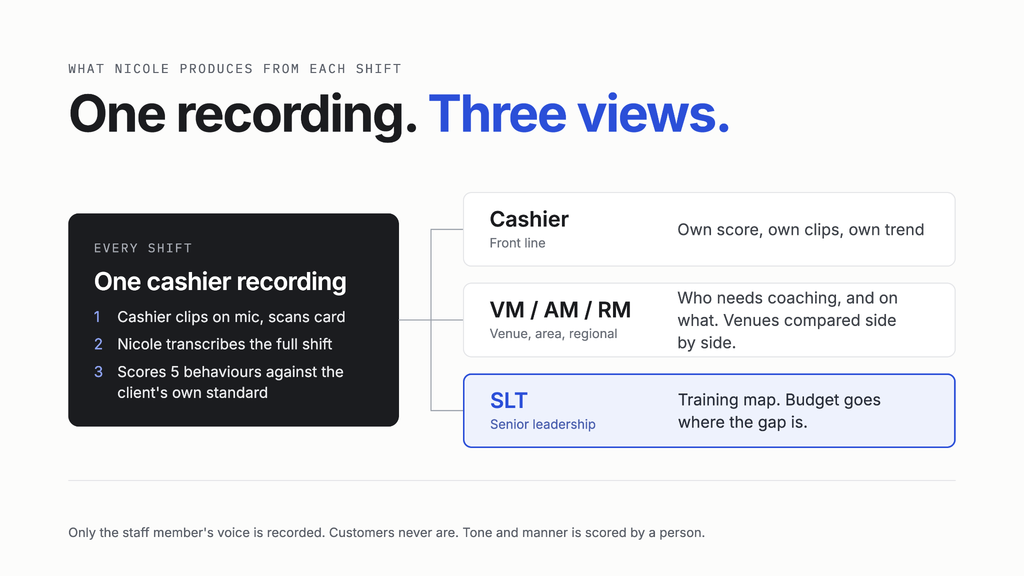
Nicole is an AI agent developed by AISensum. At the start of a shift, the Cashier clips on a small microphone and scans their employee card. Nicole listens to the Cashier’s side of the shift, transcribes it and checks it against the client’s own service standard. It looks for four things: whether the customer was welcomed, whether the offer was made, whether the customer was thanked, and whether the device was worn properly for the shift. Where a step is missed, Nicole marks the moment so that it can be played back.
What Nicole does not do matters just as much. It does not record customers. The microphone picks up only the staff member’s voice. It does not judge mood, emotion, personality or how anyone sounds; those belong in a human conversation, not in a score. And it does not have the final word. What Nicole flags can be reviewed, and overruled, by a human who is the Quality Reviewer. AISensum calls this putting the human in the lead.
All three show up at the counter with Nicole. Nicole listens to the whole shift, so nobody is judged on one bad afternoon. Its score does not get irritated, play favourites or remember who was late last week, which gives a Manager steady ground for a difficult conversation. And by playing back the exact moment a step was missed, it turns feedback from a verdict into something a Cashier can act on.
What Nicole added was visibility. In South East Asian frontline work, a quiet frustration is that recognition tends to go to whoever is closest to the Manager. A Cashier in one venue has no way of proving they are the best in the chain, because nobody outside their venue ever sees them work. A score that everybody can see changes that. One tree, at last, visible from the edge of the forest.
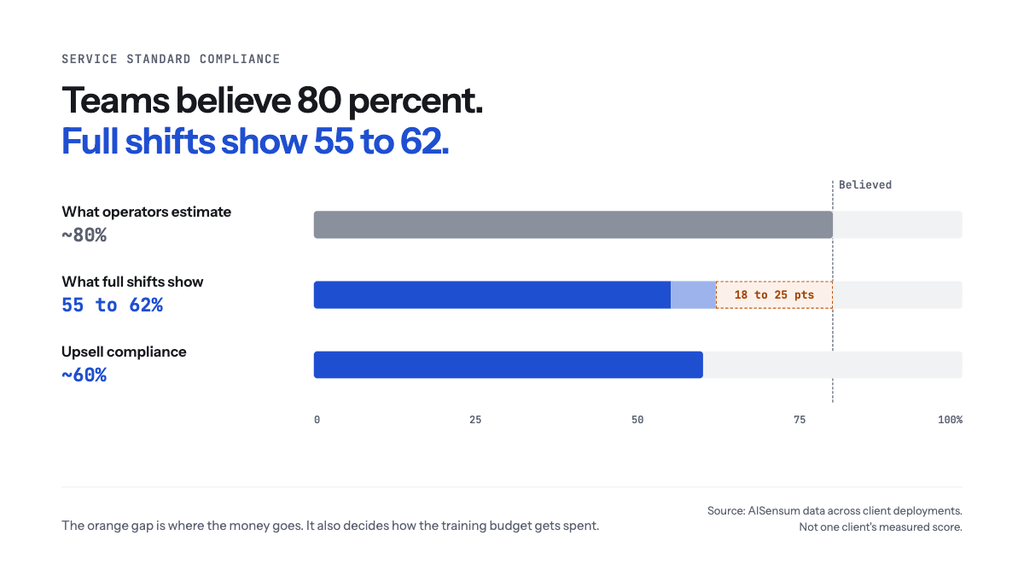
That gap is where money quietly leaks away. It also shapes the training budget. If five Cashiers are skipping the welcome and eight are missing the offer, a manual system has no way of picking them out, so all three hundred people in the cluster sit through the same refresher. It is expensive, and for the many who were doing perfectly well, a waste of time.
Empathy, with a purpose
It would be easy to dismiss all this as surveillance with better software. That would misread the design. Nicole was built around an idea about how people actually improve, and it borrows from a well-established way of thinking about empathy. The psychologist Paul Ekman, whose work on emotions has shaped the field for half a century, distinguishes three kinds of empathy, a framework Daniel Goleman, the author of “Emotional Intelligence”, has done much to popularise.
Nicole has been built on this Empathy Triangle.
Cognitive empathy is knowing what another person feels and thinks, seeing the situation from where they stand. Emotional empathy is feeling what they feel. Goleman warns that this, left unmanaged, ends in distress and burnout, which is why the useful skill at work is to stay calm, honest and steady rather than be swept along. Emphatic Concern, the third, joins understanding to action: being moved to help someone get better.
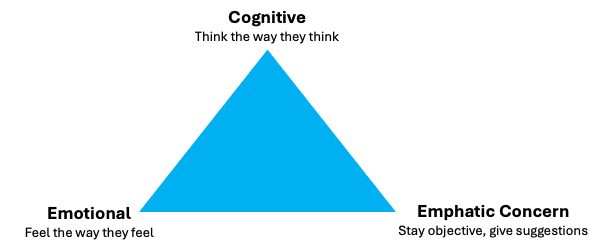
All three show up at the counter with Nicole. Nicole listens to the whole shift, so nobody is judged on one bad afternoon. Its score does not get irritated, play favourites or remember who was late last week, which gives a Manager steady ground for a difficult conversation. And by playing back the exact moment a step was missed, it turns feedback from a verdict into something a Cashier can do something about.
Accountability runs alongside. The card scan makes each Cashier answerable for their own shift. The Quality Reviewer makes the system answerable to the people on the floor. Trust, in the end, comes from both sides looking at the same facts and both being held to them. The people at the chain put it better than any framework can.
The Impact : Managers having a different conversation
Budi* runs a venue. For years, coaching a Cashier meant relying on his memory, or on being in the right place at the right moment.
“Before, I had to remember how a shift went, or be standing there when it happened. Now I open the score and I can see which of the three things needs work, the welcome, the offer or the close. It is easier for me to tell a Cashier what to fix. It is easier for them to hear it, because we are both looking at the same number.”
– Budi*, Venue Manager
What changed for him was less the technology than the conversation. A talk that begins with a shared number is calmer than one that begins with a Manager’s recollection of a Tuesday afternoon. The Cashier has less reason to be defensive, because the evidence is not a matter of opinion. The Manager has less reason to feel awkward, because he is no longer asking to be believed.
* Names have been changed to protect staff privacy and the confidentiality of the client.
The Impact : Cashier being seen at last
Puttu* started near the bottom of his venue.
“My welcome, my offer, my thank you, were not all that great…so I began listening back to my own recordings to hear where I was falling short. Slowly my scores went up until it was the highest across all the venues, not only mine. The Area and Regional Managers saw it because the scores showed it to them.”
– Puttu*, Cashier
Nicole gave Puttu something he had never had before: a clear picture of his own shifts. Instead of a vague sense that he needed to do better, he could see exactly which step he was missing, and play back the moment it happened. Each week, his score showed him whether the changes he made were working. Feedback that once came months late, if at all, now arrived while the shift was still fresh in his mind.
What Nicole added was visibility. In Indonesian frontline work, a quiet frustration is that recognition tends to go to whoever is closest to the Manager. A Cashier in one venue has no way of proving they are the best in the chain, because nobody outside their venue ever sees them work. A score that everybody can see changes that. One tree, at last, visible from the edge of the forest.
The Quality Reviewer: who has the final say
The most telling story at the chain is about Nicole getting it wrong.
“I listened to what Nicole flagged, and I overruled it. The greeting was in a regional language and the standard asks for standard Bahasa, so the system marked it as a deviation. It was the right greeting for that customer. We changed the standard.”
– Fahmi*, Quality Reviewer
This is what putting the human in the lead looks like in practice, and at the chain that human has a specific job. The Quality Reviewer listens to what Nicole flags and decides whether it stands. Here the system applied the rule as written. Fahmi* understood the moment better, overruled it, and the standard itself improved as a result.
Any quality system that cannot be overruled by the people who know the floor will be gamed within a quarter. So the roles are kept distinct. Nicole surfaces the facts. The Quality Reviewer checks them. The Manager coaches. And when the Reviewer disagrees with Nicole, the Reviewer’s call stands and that learning is injected back into Nicole.
* Names have been changed to protect staff privacy and the confidentiality of the client.
One recording, a view for everyone
The same shift recording serves everyone up the line. The Cashier sees their own score, their own clips and their own trend. The Venue Manager sees who needs coaching, and on what.
The Area Manager compares venues side by side. The regional team sees a training map of the whole chain.
That last view changes how money is spent. Training twenty-five people on the welcome and forty on the offer costs a fraction of sending three hundred through everything. It is kinder, too. People are coached on what they actually need, and nobody sits through a course that was never meant for them.
What we can claim, and what we cannot
Case studies have a habit of overreaching, so it is worth being plain. Coverage went from under five percent of shifts to all of them. Four service steps (Welcome, Upsell Offer, Thank you and whether the device was worn properly for the shift) used to be matters of opinion are now numbers the Manager and the Cashier can both see, and feedback arrives the same week rather than at a monthly review, if one happened at all.
AISensum’s own modelling suggests that every ten-point rise in compliance is worth roughly two percent in revenue. That is a model, not this client’s result.
| Before | After | |
| Shifts covered | 3 to 4 a month | Every shift |
| Who is seen | Whoever the Manager happened to observe | Every Cashier, tied to their card scan |
| Basis of a coaching conversation | What the Manager remembered | The same score the Cashier can see |
| What is measured | The Manager’s general impression | Four service steps, never emotion or personality |
| Customer audio | Not applicable | Never recorded, by design |
| Feedback timing | Monthly review, if it happened | Same week |
Back at the counter
The queue is still long and the Cashier is still saying “good evening”. What has changed is that her shift now counts, all of it. When someone sits down with her to talk about her work, they will both be looking at what she actually did, and she will be able to hear it for herself.
If your Managers are still reviewing 3 shifts out of 22, what would you do with the other 19?
See the other 19 shifts.
Book a thirty-minute frontline quality review with AISensum.
We map your own service standard onto what Nicole measures and show you how every Cashier’s shift would be scored on your SOPs. You will see who needs coaching on what, so your training budget goes only where it is needed. And using your own figures, we will estimate what a ten-point rise in compliance could add to your sales.
18 years in Digital Marketing and AI in Indonesia. Championing the 'Human in the Lead' movement by deploying AI Teammates that streamlines execution, elevates frontline talent, and keeps human strategy in command.