
Agentic AI vs No-Code Automation

A senior executive at a large BFSI company once asked a simple question.
“Do you have a no-code or low-code AI platform?”
On the surface, the question sounded reasonable.
After all, the technology industry has spent years promising a future where automation becomes plug-and-play: drop in a model, connect a few systems, and watch workflows run themselves.
But that question reveals why so many enterprise AI initiatives fail.
According to MIT research, around 95% of enterprise AI projects fail to deliver measurable value.
Not because the models don’t work.
But because organisations confuse AI aspiration with AI execution.
There is a growing belief that AI innovation simply requires a powerful model and a no-code interface.
That belief is fantasy.
You don’t perform surgery because you watched a YouTube video.
And you don’t automate complex enterprise workflows by connecting two boxes in a drag-and-drop interface.
Models are becoming commoditised.
Orchestration is not.
Understanding the difference between no-code automation and agentic AI requires looking beyond marketing claims to the realities of production systems.
What Is Agentic AI?
Agentic AI refers to AI systems that can perceive information, plan actions, and execute tasks to achieve a defined goal without constant human prompting.
Unlike generative AI, which produces content or answers questions, agentic AI systems take action within business workflows.
They combine three key capabilities:
Perception
Monitoring data across systems, transactions, and operational events.
Planning
Determining the steps required to achieve a business objective.
Execution
Taking action automatically within defined boundaries.
This ability to analyse, decide, and act is what distinguishes agentic AI from traditional automation.
If you’d like to understand this in more depth, read our full guide:
➡ What Is Agentic AI?
Agentic AI vs No-Code Automation
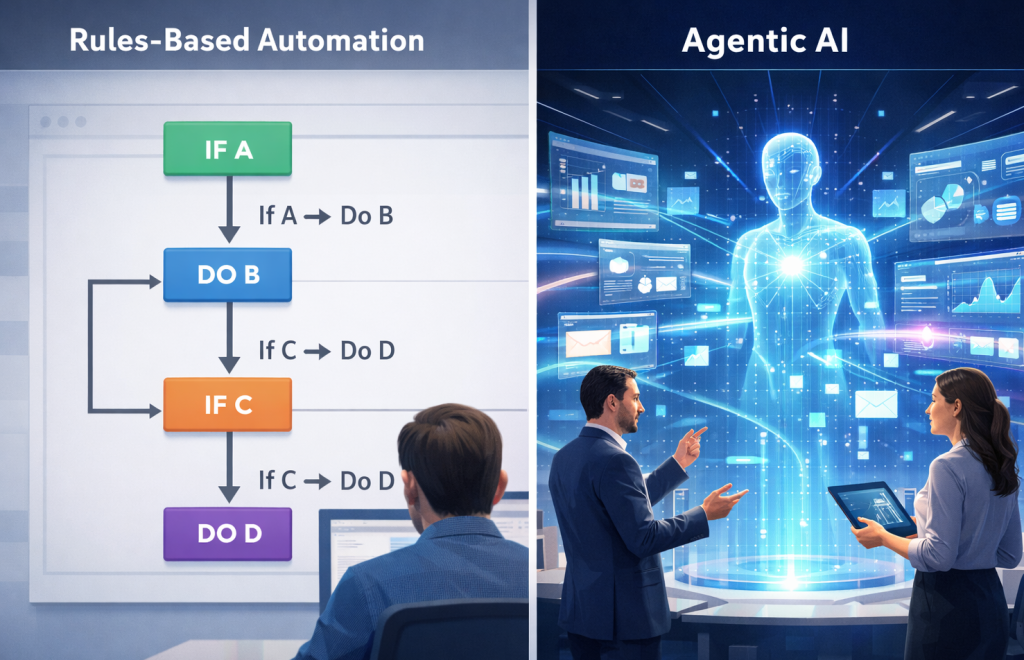
The difference between no-code automation and agentic AI ultimately comes down to rules versus reasoning.
| Approach | How It Works | Best Use Case |
| No-Code Automation | Follows predefined workflows and rules | Simple, repetitive tasks |
| Agentic AI | Reasons about goals and adapts actions | Complex operational workflows |
No-Code Automation
No-code automation platforms allow users to create workflows without writing code.
They typically work through rule-based triggers, such as:
“If event A happens, execute action B.”
This works well when:
- Data is structured
- Conditions are predictable
- Workflows rarely change
Examples include:
- Notification triggers
- CRM lead routing
- Form processing
Agentic AI
Agentic AI systems operate differently.
Rather than following static rules, they:
- Analyse multiple data sources
- Interpret context
- Make decisions dynamically
- Adjust actions as conditions change
This makes them suitable for complex enterprise workflows involving multiple systems and inconsistent data.
The Production Reality: Why No-Code Automation Fails Silently
One of the most dangerous aspects of no-code automation failures is that they often fail silently.
Unlike traditional systems that crash loudly with error messages, no-code workflows frequently appear to work whilst quietly introducing errors.
Examples include:
- Leads routed to the wrong teams
- Incorrect summaries generated from unstructured data
- Expensive APIs triggered unnecessarily
- Incomplete data passing through pipelines
Because these systems often log “success,” organisations may not realise something is wrong until the downstream business impact appears.
Research into no-code platforms consistently highlights several limitations:
- Poor scalability for complex workflows
- Limited integration capabilities
- Governance and compliance challenges
- Vendor lock-in risks
These issues become critical when business decisions depend on data flowing correctly across multiple systems.
Case Study: When No-Code Automation Breaks Down
A leading pharmaceutical company in Indonesia faced exactly this challenge.
The company received sales data from seven different distributors, each with its own format.
The organisation attempted to standardise the reporting process using automation tools.
But the transformation logic required to interpret these inconsistent datasets was too complex for rule-based automation.
The result was a familiar pattern:
Manual copy-pasting.
A two-week reporting cycle.
High error rates.
This is where agentic AI systems outperform rule-based automation.
Agentic AI in Production: Real Examples
ROT Sasha: Automating Distributor Reporting
When the pharmaceutical company deployed ROT Sasha, an agentic AI teammate designed for operational automation, the reporting workflow changed dramatically.
The system could:
- Interpret multiple distributor formats
- Standardise the data automatically
- Validate accuracy across datasets
The results were measurable.
- Reporting time reduced from two weeks to hours
- Teams redeployed from manual data work to analysis
- Copy-paste errors eliminated
The difference wasn’t speed.
It was intelligent orchestration across systems.
G-Tech Digital Asia: Scaling Image Production
Another example comes from G-Tech Digital Asia, an e-commerce enabler responsible for large-scale product content production.
The team was spending enormous effort on repetitive image editing tasks.
By deploying ROT Sasha for image processing automation, the organisation achieved:
- Unlimited image processing capacity
- Consistent output quality
- Error rates reduced to 5-7%
- Teams freed from manual editing work
Instead of spending time on repetitive production work, the team could focus on creative and strategic tasks.
When No-Code Automation Works Well
No-code automation is still extremely useful in the right context.
It works best when processes are simple, structured, and predictable.
Use No-Code Automation When
- Data is structured and consistent
- Workflows follow simple if/then rules
- Operational scale is manageable
- Failures have limited business impact
- Speed of deployment is critical
Common examples include:
- CRM alerts
- Notification triggers
- Basic workflow routing
When Agentic AI Is the Better Choice
Agentic AI becomes necessary when workflows become more complex.
Use Agentic AI When
- Multiple systems and datasets must be integrated
- Data formats vary significantly
- Decisions require context or judgement
- Errors carry significant business risk
- Real-time insights are required
In these scenarios, rule-based automation often breaks down.
The Hybrid Model: The Best Enterprise Strategy
Most sophisticated organisations do not choose between no-code automation and agentic AI.
They combine both.
Use No-Code For
- Simple workflow triggers
- Notifications and alerts
- Low-risk operational tasks
Use Agentic AI For
- Data transformation across systems
- Intelligent decision-making
- Strategic operational workflows
- Real-time insights
This hybrid approach allows organisations to maximise efficiency whilst maintaining reliability for mission-critical processes.
The Future of Enterprise Automation
The next phase of automation will not be defined by models alone.
Models are already commoditising.
The real competitive advantage lies in orchestrating AI systems across business workflows.
AI does not remove complexity.
It often amplifies it.
And the organisations that succeed will not simply deploy models.
They will build systems capable of turning AI into:
- Revenue growth
- Time savings
- Operational quality improvements
In other words:
Execution, not experimentation.
Conclusion
The debate between agentic AI and no-code automation is often framed as a technology choice.
In reality, it is a question of workflow complexity.
No-code automation works well for simple, predictable tasks.
But when organisations attempt to automate complex, multi-system processes, rule-based automation quickly reaches its limits.
Agentic AI succeeds in these environments because it can interpret context, adapt to changing conditions, and orchestrate actions across systems.
The question enterprises must ask is simple:
When your AI pilot stalls…
Who in your organisation actually knows how to fix it?
About AISensum
AISensum builds agentic AI Teammates that augment your workforce, not replace it. Our three AI Teammates; ROI Daniel (sales optimisation), ROT Sasha (operational automation), and ROQ Nicole (quality control) are deployed across enterprises globally and in Indonesia, delivering measurable results through proven implementation partnerships.
Ready to transform your business with agentic AI? Schedule a demo with our team or chat with AI Vivek for instant answers about your specific use case.
Frequently Asked Questions
No. No-code automation is highly effective for simple workflows. Agentic AI becomes valuable when workflows involve multiple systems, complex decisions, or high-impact business processes.
Implementation timelines vary depending on complexity, but many enterprise deployments deliver measurable value within 4-8 weeks.
Yes. The most effective enterprise automation strategies combine both approaches: no-code for simple tasks and agentic AI for complex workflows.
The most common risk is silent failure, where workflows appear to work but introduce hidden errors that affect downstream decisions.
18 years in Digital Marketing and AI in Indonesia. Championing the 'Human in the Lead' movement by deploying AI Teammates that streamlines execution, elevates frontline talent, and keeps human strategy in command.